Ellis Peters · 16 September 2026
Precision Content Iteration for Sustaining Topical Clusters Amid Algorithmic Shifts in Search Ecosystems
Search ecosystems rely on topical clusters that group related content around core themes, and precision content iteration provides a method for maintaining those structures when algorithms update their ranking signals. Observers note that search engines refine how they evaluate relevance, authority, and user intent on a regular basis, which forces content teams to adjust existing material rather than create entirely new pages. Data from industry reports indicates that sites maintaining tight topical clusters experience steadier traffic patterns during major updates compared with those using scattered keyword approaches.
Understanding Topical Clusters in Modern Search
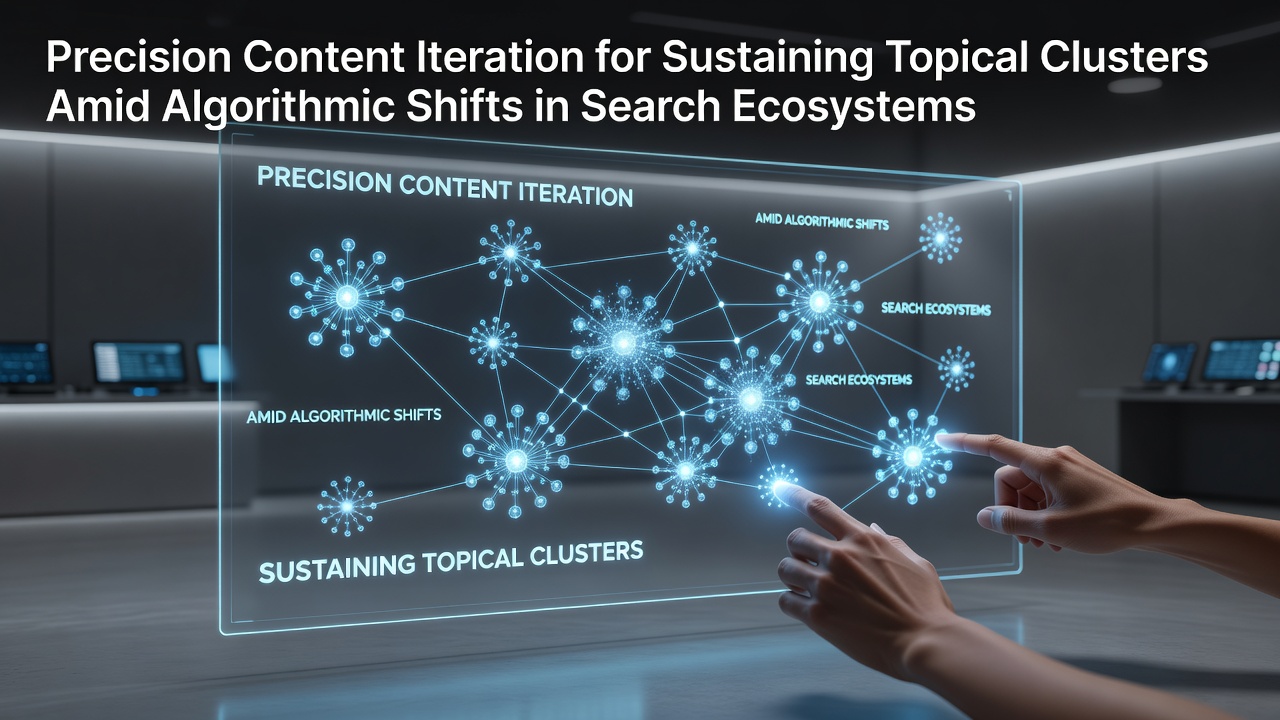
Topical clusters consist of pillar pages supported by cluster content that links back to the central theme while covering subtopics in depth, and this structure helps search systems recognize a site's expertise within a subject area. Researchers have documented that algorithms now prioritize semantic relationships over isolated keywords, so clusters built around entities and concepts tend to hold rankings longer when signals shift. Studies show that pages within well-formed clusters receive internal link equity that reinforces the overall topic, which becomes critical when external factors like backlink profiles fluctuate.
Precision iteration enters the picture because clusters require ongoing refinement instead of one-time construction, and teams track performance metrics to identify which subpages need updates to realign with new algorithm priorities. Evidence suggests that without this iteration, even strong clusters can lose visibility when search engines adjust their handling of freshness or entity recognition.
Algorithmic Shifts and Their Effects on Clusters
Search algorithms undergo changes that alter how content quality and topical depth receive evaluation, and these modifications often occur without advance notice to publishers. In September 2026, several documented updates refined the weighting of user engagement signals within established topical areas, which prompted immediate adjustments across multiple clusters. Figures from analytics platforms reveal that sites practicing regular content audits recovered visibility faster than those relying on static structures.
What's interesting is how these shifts emphasize entity consistency and contextual depth, so clusters that previously ranked well through volume alone now demand tighter alignment between pillar and supporting content. Observers have recorded cases where minor phrasing changes in cluster pages restored rankings after an update, while untouched clusters continued to decline.

Methods for Precision Content Iteration
Teams begin by auditing cluster performance through search console data and traffic analytics, then identify pages showing declining impressions or engagement that no longer match current intent signals. Iteration proceeds through targeted rewrites that strengthen semantic connections without altering the core topic, and this process often involves refreshing statistics, adding entity references, and improving internal linking patterns. Research indicates that such focused changes produce measurable lifts when applied consistently across related pages rather than in isolation.
One documented approach involves mapping cluster content against emerging query patterns, after which writers adjust headings and supporting text to reflect updated language usage while preserving the original pillar framework. Data shows that this method sustains cluster integrity because it avoids the disruption of adding unrelated pages that could dilute topical focus. Those who've implemented systematic iteration cycles report that quarterly reviews aligned with known algorithm change windows help maintain stability.
Monitoring and Adaptation Practices
Continuous monitoring forms the backbone of sustained clusters, and teams rely on tools that track ranking fluctuations alongside content freshness indicators. When algorithms introduce new evaluation layers, such as enhanced handling of multimedia within textual clusters, iteration extends to incorporating relevant supporting elements that reinforce the main theme. Evidence from multiple site audits demonstrates that clusters incorporating timely updates to subtopics maintain higher average positions than static counterparts during transition periods.
But here's the thing: successful adaptation depends on distinguishing between temporary ranking noise and structural issues within the cluster itself, which requires cross-referencing multiple data sources before making changes. Academic papers on information retrieval have highlighted the value of iterative refinement in dynamic ranking environments, and practitioners apply these principles by testing small variations across cluster pages before scaling adjustments.
Conclusion
Precision content iteration supports the longevity of topical clusters by enabling targeted responses to algorithmic shifts without dismantling established structures. Research shows that sites adopting these practices experience more consistent performance across update cycles, while data from ongoing monitoring confirms the importance of maintaining semantic alignment within clusters. Observers note that this approach continues to evolve alongside search systems, providing a framework for sustained visibility as ecosystems refine their evaluation methods.